
Real Money Casino Table Games in Australia
 Available in AU
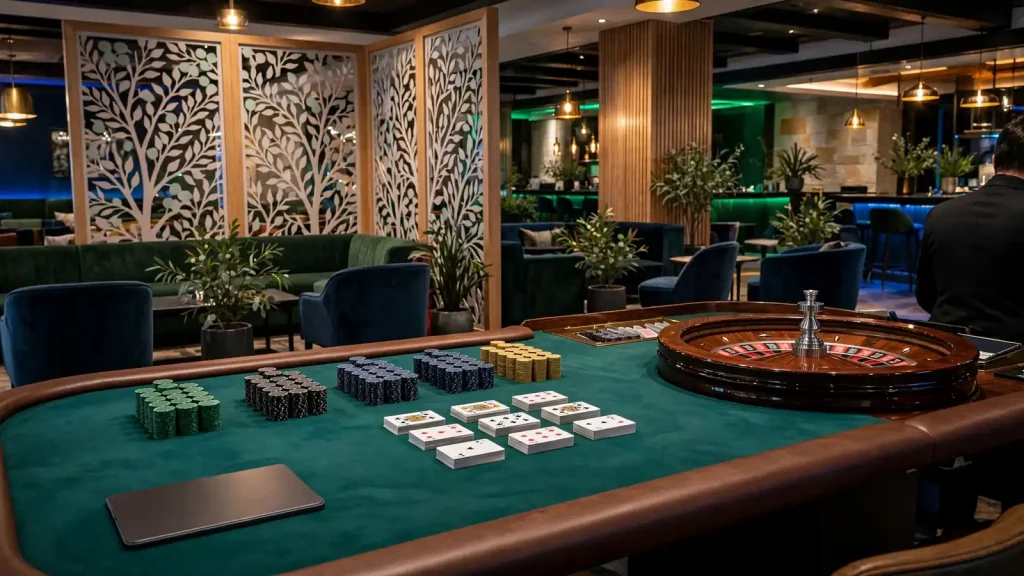
Compare streamed physical tables with RNG-based games and see how table formats, rules and player decisions shape play.
Table of Contents
- How Online Table Games Generate Their Results
- Bitcoin Payments and Table-Game Play
- What the Available Facts Do—and Do Not—Show About Game Odds
- How the Main Table-Game Decisions Work
- What “Near Me” Means for Online Table Games in Australia
- What Counts as a Casino Table Game?
- How Table-Game Formats Differ
- Card-Based Table Games: Hands, Opponents and Outcomes
- Roulette Wheels, Rules and Free-Play Versions
- Poker at the Table: The Aim of Building a Stronger Hand
How Online Table Games Generate Their Results
Online table games can show a real table through a live video feed or produce results within software. The distinction is about how the game’s events are created and presented: one format streams a dealer and casino equipment, while the other uses a Random Number Generator (RNG) to determine outcomes such as cards dealt or a roulette ball’s landing place.
Live-dealer tables: a streamed physical game
A live-dealer game takes place at a real table. A dealer handles the casino equipment, and a camera streams the action to players. The images you see are therefore a live view of a physical game in progress, rather than an animation generated to represent a dealer and table.
The stream is the link between the table and the player’s screen. The dealer’s actions and the equipment are visible through video; the game’s result comes from what happens at the table. This makes the presentation different from a software-based game, even though both are accessed online.
When you watch a live table, you are watching the dealer carry out the game in real time. The video does not itself determine the result: it shows the physical action taking place. That distinction helps separate the source of an outcome from the way the outcome reaches you. In a live-dealer format, the equipment and dealer are physical; the stream conveys their activity to your device.
Choosing real-money table games in Australia means weighing practical details alongside the games themselves. Use these notes to see which verified operator details may matter for your play.
1. Kingmaker
Payout speed: crypto ~90 minutes, fiat 1-5 days · Min. deposit: A$30 Kingmaker lists crypto payouts at around 90 minutes and fiat payouts at 1–5 days. The minimum deposit is A$30.
2. DragonSlots Casino
License: Curacao Gaming Authority (Jumpman Gaming Ltd) DragonSlots Casino is listed under the Curacao Gaming Authority, with Jumpman Gaming Ltd named as the operator.
3. Lucky Dreams
License: Curacao · Min. deposit: A$20 (POLi) Lucky Dreams lists a Curacao licence and a minimum deposit of A$20 via POLi.
4. Ricky Casino
Payout speed: crypto under 1 hour, PayID 1-3 business days · Min. deposit: A$20 (A$30 to qualify for the bonus) Ricky Casino lists crypto payouts in under an hour and PayID payouts in 1–3 business days. Its minimum deposit is A$20, or A$30 to qualify for the bonus.
5. Uptown Pokies
License: Curacao (operating since 2017) · Min. deposit: A$20 Uptown Pokies lists a Curacao licence and has been operating since 2017. Its minimum deposit is A$20.
6. 7Bit Casino
License: Curacao, operated by Dama N.V. 7Bit Casino is listed as licensed in Curacao and operated by Dama N.V.
7. Roby Casino
License: Curacao eGaming (Roby Games Ltd) Roby Casino lists a Curacao eGaming licence, with Roby Games Ltd named as the licensee.
8. SkyCrown
License: Tobique Gaming Commission · Payout speed: crypto ~10-15 minutes, fiat 1-5 days · Min. deposit: A$30 SkyCrown lists a Tobique Gaming Commission licence. Crypto payouts are listed at around 10–15 minutes, while fiat payouts take 1–5 days; the minimum deposit is A$30.
9. Golden Pokies
License: Curacao Golden Pokies is listed as licensed in Curacao.
10. Thor Casino
License: Curacao – Antillephone N.V. (Versus Odds B.V.) · Min. deposit: EUR 20 Thor Casino lists a Curacao licence through Antillephone N.V., with Versus Odds B.V. named alongside it. Its minimum deposit is EUR 20.
Software-based tables: results determined by an RNG
A software-based table game does not rely on a streamed physical table to produce its result. Instead, an RNG determines the outcome. In a card game, it determines which cards are dealt; in online roulette, it determines where the ball lands on the wheel.
The RNG is the result-generating mechanism. The screen presents the game, but the cards or roulette result are determined by the software rather than by a dealer handling physical equipment in a streamed casino. A digital table can resemble a traditional table visually, yet its appearance does not make it a live-dealer game. The relevant question is whether the result comes from a real game shown on video or from an RNG.
This distinction matters when you interpret what is on screen. In a live stream, you see a dealer and actual casino equipment in use. In an RNG-based game, the interface displays the outcome that the software has determined. Both formats can present familiar table-game play online, but they do not generate results in the same way.
What the two formats share—and what they do not
Both formats let you follow a table game through an online interface, but the source of the result differs. A live-dealer table depends on the physical game being conducted by the dealer, with video carrying that action to players. An RNG-based table depends on software to determine the result, which the interface then displays.
Pokies & Games: Slots, Casinos and Online Play · Lightning Link Online Pokies in Australia: Access
It is useful to keep three things separate: the game itself, the mechanism that produces its result, and the screen through which you see it. The screen is present in both formats. It may show a live video feed or a software-rendered table. The result, however, comes either from the physical activity at the streamed table or from the RNG. Treating the interface as the mechanism can blur this difference: an animated-looking screen does not establish that a game is live, and a realistic table layout does not mean a physical wheel or dealer is involved.
The same distinction applies when considering free-play versions or real-money play. Those labels describe how a session is used, not whether its result is produced by a dealer at a streamed table or by an RNG. To identify the format, look at how the game is presented and where its result originates: a live dealer with real equipment on video, or software determining the cards or roulette outcome.
Once you know which mechanism is in use, you can understand what the display represents. A live-dealer feed shows the physical game as it unfolds. An RNG-based game shows an outcome determined by software. Neither description depends on the visual style of the interface; it depends on how the result is generated.
Do
- Distinguish between the game, the result-generating mechanism, and the screen.
- Identify whether the result comes from a physical activity or an RNG.
Don’t
- Assume an animated screen means a game is live.
- Assume a realistic table layout means a physical dealer is involved.
Bitcoin Payments and Table-Game Play
Bitcoin describes a payment method, not a table-game format. A reference to Bitcoin alongside casino table games concerns how money may be transferred; it does not identify a different version of blackjack, roulette, poker or another game. The payment method and the game’s rules are separate parts of the service.
For a withdrawal, the relevant distinction is between a platform handling a request and the Bitcoin network recording the transfer. A specialist review has reported withdrawal processing in 10–30 minutes, with the remaining delay dependent on blockchain confirmations rather than banking bureaucracy. That is a report from one review, not a dependable timing standard for every platform or transaction.
The wording “processing time” can hide more than one stage. A platform may first need to review and approve a withdrawal request. After it sends Bitcoin, the transaction still needs confirmation on the blockchain. The reported timing associates the final wait with those confirmations, but does not establish that every request is approved immediately or that every transfer completes within the stated range. Treating the reported interval as a guaranteed arrival time would therefore overstate what it means.
This also explains why a Bitcoin withdrawal should not be compared directly with a bank transfer by looking only at a single time estimate. The route is different: the Bitcoin transfer depends on blockchain confirmation, while a bank transfer moves through banking systems. A reported processing interval does not, by itself, tell you how long account checks take, whether a request is eligible for withdrawal, or what conditions apply to a particular service.
3-Reel Slots in Australia: RTP, RNG and Play · Best 5-Reel Slots in Australia: Bonuses and RTP
Searches for Bitcoin table games can blur two separate questions: what happens at the table and how funds move to or from an account. Bitcoin does not, simply by being used for payment, change the decisions available during a hand, the layout of a roulette wheel, or the structure of a dice bet. Nor does a payment method establish that one game has better odds than another. Those features belong to the game, not the withdrawal rail.
The distinction matters when a phrase such as “Bitcoin table games” is used loosely. It may describe table-game play associated with a Bitcoin payment option, rather than a special category of games built around Bitcoin. A digital currency transfer takes place outside the game’s decision sequence: the player makes a payment request, the service handles it, and a blockchain confirmation records a transfer. None of those steps turns a table-game outcome into a Bitcoin-based outcome.
A timing figure from a specialist review should be read as a reported observation, not a promise about a future transaction. Confirmation timing can affect when a transfer is recorded, and a review’s estimate cannot guarantee what will happen in an individual case. The distinction is useful even when the quoted interval sounds precise: it describes the reviewer’s reported experience or assessment, not a fixed service condition that applies everywhere.
So, when considering references to Bitcoin and table games, keep the payment question narrow. That statement is about the transfer process only. It does not establish a universal withdrawal speed, describe the rules of any table game, or provide a basis for ranking games.
Processing time for Bitcoin withdrawals can include both the platform’s approval period and the time required for blockchain confirmations.
What the Available Facts Do—and Do Not—Show About Game Odds
A claim that one table game offers the “best odds” needs a defined basis for comparison. House edge and return figures can support such a ranking, but a game’s name or a description of its equipment cannot. Wheel layouts, for instance, identify differences between roulette versions; they do not, on their own, establish which table game gives a player the most favourable long-run expectation.
Online roulette is offered in European, French and American versions. European and French wheels have 36 numbered spaces and a green zero. The American wheel has a green zero and a green double zero. Those details describe the layouts. They do not supply a house-edge figure or return percentage, so they cannot support a numerical ranking of roulette against other table games.
The distinction matters because a layout is only one part of the information needed to assess odds. A comparison also needs a stated measure and figures calculated on the same basis. Without those, labels such as “best” and “worst” can sound precise while leaving unclear what is being compared. A house-edge chart is useful only if its entries are reliable and refer to comparable rules and versions.
For you as a reader, the practical test is to separate a description of play from evidence about expected returns. A statement that two roulette versions have different layouts is a claim about their equipment. A statement that one has better odds is a comparative claim about outcomes. The first does not prove the second. Nor does a confident-sounding ranking become dependable merely because it names several familiar table games.
Mines Casino Game in Australia: What to Verify · 7-Reel Slots in Australia: RTP and Free Play
This also limits what can responsibly be said about the best odds at casino table games. The roulette layouts establish that the versions are not identical, but they do not justify naming a winner among roulette, blackjack, baccarat-style betting, dice games and poker. Those games have different structures, and a fair comparison would need consistent, game-specific figures. A blanket “best table games” list without that basis risks turning an unsupported impression into advice.
The same caution applies to claims about the worst odds. A game cannot be placed at the bottom of a ranking just because its rules look more complex or because a particular version is unfamiliar. Complexity and wheel layout are not substitutes for a measured return or house edge. If a comparison gives no basis for its ranking, treat the ranking as an opinion rather than a calculation.
When assessing a claim about casino table-game odds, look for the exact game version, the relevant rules, and a clearly defined measure. For roulette, distinguish the European and French layout from the American one, including the extra green double-zero space on the American wheel. That is a concrete mechanical difference, not a complete odds analysis.
The responsible conclusion is narrow: the named roulette variants and their layouts can be identified, but those details alone do not establish a best-odds or worst-odds table-game ranking. A sound comparison requires figures, not a guess inferred from the game’s name or appearance.
How the Main Table-Game Decisions Work
Table games can ask you to make different kinds of decisions. In some, you compare your result with a dealer’s; in others, you choose which hand or outcome to back. Poker centres on the strength of a hand, while a dice game makes the roll itself the event you bet on. These differences help explain how to play casino table games at a basic level, without treating every table as if it follows the same decision pattern.
Blackjack
Compare your hand value with the dealer’s, aiming to be closer to 21.
Baccarat-style
Choose which outcome to back: your hand, the Banker’s hand, or a tie.
Dice Games
Place a wager on the outcome produced by the roll of a pair of dice.
Poker
Compete against other players to build the strongest possible hand.
Blackjack: compare your hand with the dealer’s
In blackjack, your objective is to finish with a hand value closer to 21 than the dealer’s. The central comparison is between two totals: yours and the dealer’s. Your decisions relate to the hand you are trying to bring closer to that target, while the dealer provides the opposing result.
That structure differs from a game in which you simply select a result before an event occurs. In blackjack, the player’s hand is directly set against the dealer’s hand. To understand the basic aim, keep that comparison in view: the target is not to beat another player’s hand, but to be closer to 21 than the dealer.
Baccarat-style betting: choose a hand or a tie
In baccarat-style betting, the decision is which outcome to support. You can bet on your hand, the Banker’s hand, or a tie. The choice is therefore about predicting which of the listed outcomes will apply, rather than building a poker hand or comparing your own hand with a dealer’s as in blackjack.
When learning this structure, separate the three selections before considering the result: your hand, the Banker’s hand, and a tie. Each is a distinct betting option. The basic question is which one you are backing.
Dice games: bet on the roll’s outcome
A dice game of this type uses a pair of dice. Players roll them and place a bet on the outcome. The sequence is straightforward at a high level: a wager is tied to what the dice produce, and the roll supplies the event being predicted.
Crash casino games in Australia: rules and play · Best Pokies in Tasmania: Venue Checks and Legal Limits
This makes the decision different from blackjack, where your hand is compared with the dealer’s, and from baccarat-style betting, where you choose a hand or tie. In a dice game, the focus is the result of the pair of dice. The details of a particular bet depend on the game’s rules, so the basic description is best understood as a wager on the roll’s outcome.
Poker: compete through hand strength
Poker is organised around players competing to build the best possible poker hand. The main objective is therefore to make a hand strong enough to prevail against the hands of other players. Unlike blackjack’s comparison with a dealer, poker places players against one another.
This gives the decision a different centre: hand strength. The aim is not simply to select a named outcome or bet on a dice roll. Players are trying to build the strongest possible hand in the contest. That basic objective is enough to distinguish poker from the other table-game structures described here.
When you learn the main table-game decisions, first identify what the wager or contest is about: a hand compared with the dealer, a selected hand or tie, a dice outcome, or the strength of a poker hand. That distinction clarifies how each game is structured without implying that their rules or decisions are interchangeable.
What “Near Me” Means for Online Table Games in Australia
“Near me” can refer to two different things: a physical casino close to your location, or an online service that can be reached from your device. They are not interchangeable. A nearby venue is a place you travel to; an online casino is a service provided over the internet. Searching for table games available online does not establish that the service may legally be offered to someone in Australia.
Legal Restrictions
Section 5 of the Interactive Gambling Act 2001 prohibits Australian-based operators from offering real-money interactive casino games to residents.
The legal distinction is important because Australian law restricts the provider, not simply the game’s format. Section 5 of the Interactive Gambling Act 2001 (IGA) prohibits operators based in Australia from offering real-money interactive casino games to residents. The Act is the central framework governing these online services. It applies to casino-style play delivered online, rather than turning an internet service into a physical venue because it appears in a local search.
The Australian Communications and Media Authority (ACMA) enforces the rules and blocks unlicensed domestic platforms. Blocking is part of the regulatory response to prohibited services; it does not mean that every site a person can find online is authorised to offer real-money casino games in Australia. Nor should the availability of a website be treated as proof that a service is lawful or reliably accessible.
This can make the phrase “closest casino” misleading when it is used for an online product. A digital table has no physical distance from you in the way a venue does. Location-based wording may describe a search for a nearby building, while an online listing may refer to a service operating across borders. The latter does not become a local casino, and its appearance on a screen does not remove the restrictions in Australian law.
The same distinction applies when someone looks for new online table games. A new title or interface does not change the legal status of the service that provides it. For residents in Australia, real-money online casino games are prohibited when offered to them under the IGA. The relevant question is therefore not only where a platform is based or whether it loads, but whether it is offering a prohibited interactive gambling service to people in Australia.
Best Aussie Online Casino Claims: Rules and Risks
If you mean a physical venue, “near me” is a question about location. If you mean online real-money play, it is a question about an internet service and the Australian rules governing its provision. Keeping those meanings separate avoids treating a nearby result, an accessible page or an overseas operator as evidence that online casino table games may lawfully be supplied to Australian residents.
What Counts as a Casino Table Game?
A casino table game is a game organised around a defined play area, a dealer or software-controlled outcome, and choices about what to wager on. The category includes card-based play, roulette and dice games. What makes these games a group is not a shared set of rules: it is the table-style structure, where a player places a bet in relation to a hand, a result or an outcome.
Online, that structure can be presented in two different ways. In a live-dealer game, a real dealer operates real casino equipment and a video stream shows the session to players. The screen is therefore carrying an actual table session rather than depicting a result generated entirely by the game software.
A software-based table game presents the play digitally. Its outcome is determined by a Random Number Generator (RNG): for example, the software can determine which cards are dealt or where a roulette ball lands. The interface may resemble a table, but the result comes from the game’s random-number process rather than from streamed physical equipment.
How results are generated
Live-dealer games use a video stream of a physical game where a dealer handles equipment. Software-based games use a Random Number Generator (RNG) to determine outcomes like card deals or roulette ball landings.
This distinction helps answer what people mean by table games in a casino. The term can describe a physical table experience or an online version that reproduces the structure of table play. It does not, by itself, tell you whether a person is dealing, how a particular game is played, or how a wager is settled. Those details depend on the individual game and its rules.
The games commonly placed in this category involve different kinds of decisions. In blackjack, the player’s hand is measured against the dealer’s. Baccarat-style betting lets a player choose which hand or outcome to back. Poker centres on players trying to make the strongest possible hand. Roulette involves bets on where the ball will land, while a dice game centres on a roll and its outcome. These examples show the range of play covered by the term without making every table game interchangeable.
The phrase “table-game software” can also refer to the software used to present an online game and determine its outcomes. That is different from casino management software, which is not the same thing as a game played at a table. A game’s visual layout alone does not establish how its result is produced: a live stream and an RNG-based version may both appear on a screen, but the result-generating process differs.
So, when you encounter a casino table game, identify its format first: is a real dealer and equipment being streamed, or is software determining the outcome? Then consider the game itself. That separates the general category from the specific rules and betting decisions that define each kind of play.
Real-Money Online Pokies in Australia: Law and Payments · Best Pokie Machine to Play in Australia: What to Know
How Table-Game Formats Differ
Table games can be grouped by the kind of decision they present: whether you are competing against a dealer, choosing which hand or result to back, or wagering on a dice outcome. These are ways to describe how play is organised, not a complete catalogue of games. Some formats may share features, so the useful distinction is what your wager is tied to.
Playing against a dealer
In blackjack, your hand is compared with the dealer’s. The objective is to finish with a hand value closer to 21 than the dealer’s. The dealer is therefore the direct opponent in the game’s central comparison: your result is not judged only against a separate player’s hand.
That structure differs from games in which you select between competing hands. It also means the main question for the player is how their hand stands relative to the dealer’s, rather than which of several named outcomes will occur. The format can be understood without treating it as a guide to strategy or as a claim about the chance of winning.
Betting on a hand or result
Another format lets you place a wager on one of two hands, or on a tie between them. The choices are the player’s hand, the Banker’s hand, and a tie. Here, the bet is attached to which hand prevails, or whether neither side wins outright; the description does not require you to play directly against the dealer.
In baccarat-style betting, the decision is based on supporting a predicted outcome rather than playing directly against the dealer.
This is a useful distinction when sorting card-based table games: a hand may be the thing being assessed, while your decision is which outcome to support. The arrangement is different from blackjack’s player-versus-dealer comparison, even though both formats involve hands. The betting choice, rather than the act of building a hand, defines this particular structure.
Wagering on dice
Dice-based play centres on a pair of dice being rolled, with wagers placed on the outcome. The player’s decision is therefore linked to what the roll produces, rather than to the value of a card hand or a comparison with a dealer.
This separates dice games from the two hand-based formats above. It does not imply that every dice game uses the same rules or offers the same betting choices: the basic description only identifies the pair of dice and the outcome-focused wager. When you encounter a table-game category, check what the wager refers to—your hand, a competing hand, or a roll. That tells you more about the format than a broad label such as “live table game,” which describes a mode of presentation rather than the structure of the bet.
Card-Based Table Games: Hands, Opponents and Outcomes
Card games at a casino table can be understood by looking at what the player is trying to compare or predict. In blackjack, your hand is measured against the dealer’s. In baccarat-style betting, you choose which hand or result to back. In poker, players compete to make the strongest possible hand. These differences shape the role a player takes at the table: opposing a dealer, selecting an outcome, or competing with other players.
Bonus Buy Slots in Australia: How They Work · Melbourne Casino Guide: Crown Stays and Planning
Blackjack: your hand against the dealer
Blackjack centres on a comparison. You compete with the dealer, aiming for a hand value closer to 21. Your hand is therefore judged in relation to the dealer’s, rather than solely against a fixed target. The central question is whether your final hand is closer to that value than the dealer’s hand.
This makes blackjack different from a bet on which of two hands will prevail: you are playing against the dealer’s hand directly. The objective is clear, but the comparison depends on both hands, so the value of yours cannot be considered in isolation.
Baccarat-style betting: choose what to back
In baccarat-style play, the betting choice is framed around the outcome. You can place a bet on your hand, the Banker’s hand, or a tie. The decision is about which of those results you expect to occur, not about building a poker hand against other players.
That distinction helps identify the structure of this type of card table game. The player selects a result to support; the named hands and the possibility of a tie define the available choices. The bet is attached to the outcome rather than to a direct contest in which you try to improve a hand against the dealer.
Poker: compete through hand strength
Poker is organised around players trying to build the best possible poker hand. Unlike blackjack’s player-versus-dealer comparison or baccarat-style betting on a named result, poker puts hand strength at the centre of the competition between players.
Card Game Differences
- Blackjack involves a direct comparison between the player’s hand and the dealer’s.
- Baccarat-style betting focuses on choosing which of several named outcomes will occur.
- Poker is a competition among players to achieve the highest hand strength.
Across these games, “hand” does not imply the same role. In blackjack, it is compared with the dealer’s. In baccarat-style betting, the hands identify outcomes you can back. In poker, players compete to form the strongest hand. Recognising that difference gives you a practical way to distinguish the main card-based table-game structures without assuming that they share the same decisions or objective.
Roulette Wheels, Rules and Free-Play Versions
Online roulette comes in several versions, with European, French and American roulette among the main formats. The clearest documented difference is the wheel’s numbered layout. European and French wheels have the numbers 1 through 36 and a green zero. An American wheel has those numbered pockets plus a green zero and a green double zero.
That extra pocket changes the set of possible landing positions. It is a feature of the wheel layout, not a change in how an online result is generated. In software-based roulette, a random number generator determines where the ball lands. The display may animate a spinning wheel, but the result comes from the software rather than a physical ball moving around a wheel.
The distinction matters when you choose a version to play, including in free-play mode. A free version can let you see how the interface presents a spin and where the zero pockets appear, without a real-money stake. Check the wheel shown on screen: a single green zero identifies the layout shared by European and French roulette, while the American layout includes both zero and double zero. The wheel itself is the useful reference point; a game’s title alone may not make the layout as easy to inspect.
The number of pockets describes the available landing positions, but it does not by itself explain every betting rule or establish which version is preferable. Keep those questions separate: first identify the wheel, then read the rules displayed for that particular game. Online roulette is not one uniform format, and the wheel layout is a practical way to distinguish its main versions.
Live Casino Online Australia: What to Know
Free play also needs to be understood on its own terms. It shows the game’s interface and lets you observe RNG-generated outcomes, but it is not a real-money round. If you move between free and real-money versions, check that the wheel and rules shown are the ones you intend to play. A familiar roulette screen can represent a different layout, so confirming the zero pockets is a simple way to avoid confusing the formats.
Poker at the Table: The Aim of Building a Stronger Hand
Poker centres on a contest to make the best possible poker hand. At a casino table, that objective gives the game its basic structure: players take part in the same contest, and the strength of a hand is central to its outcome.
The focus is not simply on receiving cards. A hand matters because it is compared within the game, with players competing against one another to build the strongest result they can. That makes poker distinct in purpose from table games built around a player challenging a dealer or betting on a particular outcome.
Casino Stays in Tasmania: What to Check Before Booking
The exact way a poker game is played depends on its version, but the shared idea remains the hand. When you consider a casino poker table game, look first at how it frames that contest: players are trying to produce the strongest poker hand possible. The objective is straightforward even when the details of a particular version differ.
This hand-based contest is what links the different forms of casino poker. The name of a variant alone does not explain how its rules work; the central point is that players compete to build a strong hand. Poker therefore belongs to the broader group of casino table games while keeping a specific aim: hand strength determines the contest’s focus.
For anyone approaching poker at a casino table, that gives a useful starting point. Think of each hand as part of a competition to create the best possible poker result, rather than as a bet on a wheel, a dice roll or a dealer’s hand. The objective is the defining feature: players battle to build the best hand they can.
Can you play table games online for real money?
Yes, online table games can be played for real money. They may use a live dealer and physical equipment streamed to you, or software that determines the results with an RNG.
Do casino bonuses actually benefit table game players?
They can, but check the bonus terms first: blackjack and roulette may contribute only 10–20% toward wagering, and some games may be excluded. Also check the maximum bet and wagering deadline.
Can you guarantee winning at table games?
No. RNG-based table game results are determined by software, and a live-dealer game’s result comes from the physical game; neither format guarantees a win.
Pokies

3-Reel Slots in Australia: RTP, RNG and Play
Understand how random outcomes, paytables and RTP relate to three-reel games, and what free play...

Best 5-Reel Slots in Australia: Bonuses and RTP
A practical guide to bonus triggers, payout calculations, RTP, free-play options and Australian access to...

7-Reel Slots in Australia: RTP and Free Play
Explore how bonus triggers, paytable RTP, real-money settings and free-play sessions shape what slot results...

Australian online pokies: legal rules and payments
A practical guide to the legal boundary, bonus terms, payment methods and claims surrounding real-money...

Best Aussie Online Casino Claims: Rules and Risks
A guide to Australian online casino rules, licensing claims, offer conditions, payment routes and the...

Aussie Online Pokies in Australia: Rules and Risks
Australia has no licensed online casinos, so access, payments, bonuses and withdrawals need careful checking....

Australian Online Pokies: Legal and Bonus Checks
A practical guide to operator legality, payment checks, game returns, bonus conditions and the limits...

Bonus Buy Slots in Australia: How They Work
A purchased entry opens a feature round, while the symbols and outcomes within it remain...

Adelaide Casino: Hotels, Dining and Visitor Guide
Guidance on accommodation, gaming, transport, food and entertainment, with checks to make before booking. Where...

Casino in Brisbane: Hotel Rooms, Deals and More
Room listings and promotional headlines can group casino accommodation differently, so property details and stated...

Canberra Casino Guide: Hotels, Games and Facilities
A practical guide to assessing accommodation, amenities and casino-related information in Canberra, with a focus...

Darwin casino: venue details to verify
Venue updates can describe proposals, work in progress or completed changes, so status and visitor...

Hobart Casino Guide: Poker, Stays and Visitor Details
The guide covers poker availability, nearby accommodation, dining, parking, facilities and other common searches connected...

Melbourne Casino Guide: Crown Stays and Planning
A practical guide to distinguishing on-site accommodation from nearby options and checking booking details before...

Crown Perth Casino Guide: Stays, Dining and Facilities
An overview of accommodation bookings, resort services, casino facilities, visitor information and limits on online...

Casino Hotels in Queensland: What to Check Before Booking
Hotel listings describe accommodation, while access, gaming, dining and venue facilities need to be checked...

Best Casino in Sydney: Rules and Visit Guide
The guide separates NSW poker-machine requirements from practical checks on accommodation, food, services and current...

Casino Stays in Tasmania: What to Check Before Booking
A practical checklist for confirming accommodation, gaming access, facilities, dining and other arrangements before a...

Casino in Victoria: Hotel, Dining and Visit Checks
A practical guide to checking hotel bookings and finding information on dining, parking, events, facilities...

Casino Hotels in Western Australia: Booking Guide
Learn how to assess hotel access, room details and booking conditions, alongside practical searches for...

Fast-payout online casinos in Australia: what to check
The guide separates payout marketing from actual withdrawal conditions, legal status and the limits of...

High-Volatility Slots in Australia: What to Expect
High volatility means larger wins may be less frequent, but it cannot predict when a...

Instant Payout Casinos in Australia: What the Claim Means
A claimed payout speed may cover only one stage; operator review and payment processing are...

Online Keno Casinos in Australia: Rules and Checks
The guide separates operator legality from player liability and covers payments, game terms, randomness, bonuses...

Low-volatility slots in Australia: how wins work
Low volatility describes a general pattern of relatively frequent, modest wins, not a fixed sequence...

Live Casino Online Australia: What to Know
A guide to live casino formats, provider details and legal scope, with a focus on...

Live Dealer Casinos Online in Australia: Legal Guide
Australian law, unverified review details and key checks can help frame an informed assessment of...

Best Pokie Machine to Play in Australia: What to Know
Access does not establish legality; understand demos, machine features, land-based options and practical checks before...

Pokies in Adelaide: venue hours and access checks
Venue listings may cover bars or dining rather than gaming, so current hours and the...

Best Pokies in Brisbane: Hours and Venue Checks
A practical guide to checking machine availability, venue hours, location details and the terms attached...

Best Pokies in Canberra: What the Facts Show
A guide to interpreting Canberra venue searches, machine-hour claims and pokie information without treating incomplete...

Pokies in Geelong: How to Check Venue Availability
Venue hours, gaming-area access and location details can differ, so availability needs venue-specific confirmation. Checking...

Melbourne Pokies: Venue Searches and Checks
A practical guide to searching by location, checking whether venues are open and understanding what...

NSW Pokies: Venue Hours and Machine Access
Venue listings, operating hours and machine access are separate checks, while past spins do not...

Pokies in Perth: venue access and what to check
Published hours may cover the venue but not its gaming area, so venue-specific checks matter...

Pokies in South Australia: Venue and RTP Guide
Pokie outcomes are random, while game settings and practical details such as venue hours can...

Pokies in Sydney: How to Verify Venue Listings
Location labels and map pins can suggest a match, but they do not confirm a...

Best Pokies in Tasmania: Venue Checks and Legal Limits
The guide focuses on confirming venue and gaming-area access, interpreting payout claims, and checking the...

Progressive Jackpot Slots: Pools, Odds and RTP
Progressive prizes grow from eligible wagers, but contribution rates, qualifying bets and payout rules vary...

Real-Money Online Pokies in Australia: Law and Payments
Understand the legal position, payment and withdrawal checks, bonus conditions and what mobile apps can—and...

Best RTP Pokies in Australia: How Returns Vary
A game title does not guarantee one return percentage: casino settings, bonus turnover and long-run...

Best RTP Slots in Australia: How RTP Works
Understand what return to player can indicate, where its limits lie, and why a displayed...

Video Slots Australia: How Spins, RTP and Free Play Work
A practical guide to RNG outcomes, free-play limits, Australian access, game features and reading return...

Big Red Pokies Online in Australia: Free Play
A look at how pokie spins are presented, how random outcomes are generated, and what...

Casino Dice Games in Australia: How They Work
Dice produce values, while each casino game's rules determine how those values shape a result....

Crash casino games in Australia: rules and play
A practical guide to round mechanics, Australian availability, payment deductions, withdrawal checks and the limits...

Lightning Link Online Pokies in Australia: Access
The guide distinguishes venue machines from online casino claims and explains the legal limits on...

Live Baccarat Online in Australia: Rules and Access
A guide to Australia’s legal position, table formats, betting flow, rules, payments and the practical...

Live Blackjack Online in Australia: Rules and Format
A live dealer changes how blackjack is presented, but it does not create an exception...

Live Roulette in Australia with English-Speaking Dealers
A guide to Australia's legal context, roulette rounds and results, variant terms, wheel odds, table...

Mines Casino Game in Australia: What to Verify
The guide separates game titles from providers and outlines what can be checked about mechanics,...

Most Trusted Online Casinos in Australia: What Trust Means
No Australian online casino licences exist, so trust checks must focus on operator claims, payment...

Plinko Casino Australia: Game Format and Risk
Plinko’s board-style presentation can look different from a traditional pokie, but the label alone does...

Pokies Tips and Tricks: Read the Odds, Set Limits
A practical framework for understanding game maths, checking bonus conditions and keeping play within a...